One focused program. One clear goal
CP-012 is our sole clinical-stage program, designed to address morning motor symptoms in people living with Parkinson's disease.
Pipeline overview

* License to formulation technology with BDD Pharma, UK
SMOL = Small Molecule


Early morning OFF is common, appears early in the disease and has a real impact on patients’ and caregivers’ daily lives. Treating it requires levodopa to be working before the patient wakes. That is the principle behind
Anne Birk Østerskov, MD
CP-012.
Chief Medical Officer
CP-012: our approach
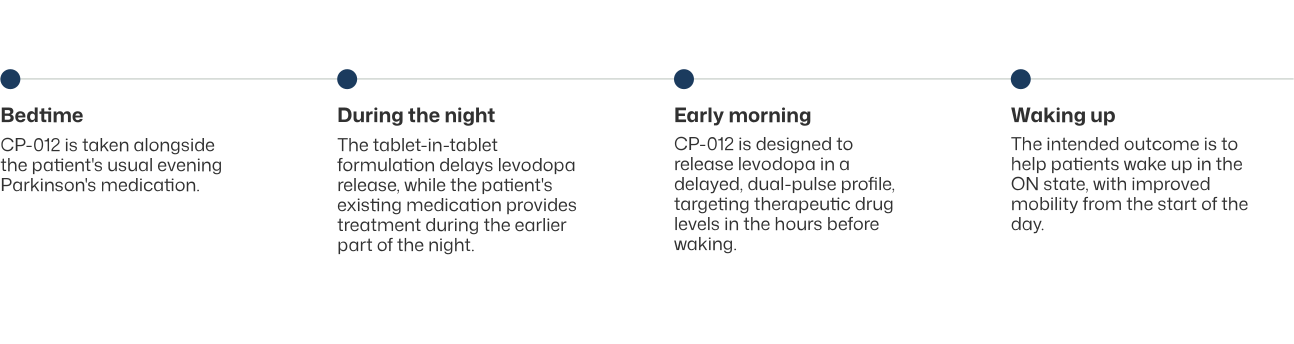
CP-012 is an investigational, delayed-release, dual-pulse levodopa/carbidopa tablet based on BDD Pharma's OralogiK™ drug-delivery technology.
Designed to be taken at bedtime in addition to existing Parkinson's medication, CP-012 aims to deliver levodopa during the late night and early morning hours, targeting the period when medication levels may otherwise be insufficient.
By providing a delayed release of levodopa before waking, CP-012 is being developed with the goal of reducing morning OFF symptoms and improving early morning mobility.
Key features
- Targeting symptoms before waking: Designed to deliver levodopa in the hours before patients wake up, rather than relying on medication taken after symptoms appear.
- Established active ingredients: Combines levodopa/carbidopa, the gold-standard therapy for Parkinson's motor symptoms, with an innovative delayed-release formulation.
- Simple to use: A bedtime tablet designed to complement existing treatment, without the need for pumps, injections or external devices.
CP-012 is an investigational product. It has not been approved by any regulatory authority, and its safety and efficacy have not been established.
Explainer video
Watch: How CP-012 could change the Parkinson's morning
Latest news
-
Lundbeck and Contera Pharma
Lundbeck and Contera Pharma announce research collaboration to advance RNA-targeting medicines for serious neurological conditions Valby, Denmark, 20 October 2025 – H. Lundbeck A/S (Lundbeck) and Contera Pharma today announced a strategic research collaboration aiming to accelerate the discovery and development of innovative oligonucleotide-based medicines for patients living with serious neurological conditions, where significant unmet medical...
-
CP-012: Positive topline results in Phase 1b trial
Contera Pharma announces positive topline results in Phase 1b trial of CP-012, a novel therapy to treat nocturnal immobility and morning akinesia in Parkinson’s disease Hørsholm, September 17, 2025 – Contera Pharma A/S, a clinical-stage biotech company pioneering innovative treatments for neurological disorders, has announced positive topline results in a Phase 1b pharmacoscintigraphic study evaluating CP-012....
-
Last patient dosed in Phase 1b trial of CP-012
Contera Pharma announces last patient dosed in Phase 1b trial of CP-012, a novel therapy to treat nocturnal symptoms and morning akinesia in Parkinson’s disease Hørsholm, August 28th, 2025 – Contera Pharma A/S, a clinical-stage biotech company pioneering innovative treatments for neurological disorders, today announced that the last patient has been dosed in its Phase 1b...